


A lab report that calls your testosterone "normal" can be the reason you still feel exhausted, soft, and mentally fogged. You can do the right things, sleep and eat well, and still have a provider wave off the fatigue because you sit inside a generic clinical range. That's a frustrating place to be. Understanding trt therapy in 2026 is less about hitting a baseline and more about getting levels that match how you actually want to feel.
This guide covers how modern trt therapy can help restore mental clarity, libido, and physical performance when it's managed proactively, not only as a last-ditch fix. We'll get into current options, including the FDA-approved oral option Kyzatrex and the 2026 telehealth extensions that make professional care easier to reach. The goal is a straightforward medical partnership that treats your results as the point, not an outdated average.
Key Takeaways
- Generic "normal" lab results often miss the symptoms you're actually living with. The more useful target is an optimal range for you.
- Comprehensive bloodwork is the blueprint for a safe trt therapy protocol, looking at total testosterone, SHBG, and estrogen together.
- Injections typically offer more reliable absorption and steadier results than topical creams.
- Telehealth lets you work with specialists and get diagnostic testing done without a traditional clinic visit.
- Peptides and medical weight loss can be added when they fit, and may help with body composition and recovery.
Table of Contents
- What is TRT Therapy? Moving Beyond the 'Normal Range' Myth
- How TRT Works: The Critical Role of Comprehensive Bloodwork
- Comparing TRT Delivery Methods: Injections vs. Gels and Creams
- The Telehealth Journey: How to Get on TRT from Home
- Beyond Testosterone: The Summit Approach to Total Optimization
What is TRT Therapy? Moving Beyond the 'Normal Range' Myth
Androgen replacement therapy, commonly known as trt therapy, is a medical intervention designed to restore testosterone to levels that support your body's peak performance. For a long time, traditional medicine only stepped in when levels fell into the extreme bottom percentile. In 2026, that view has shifted. Hormone health is treated as a proactive part of longevity, not only a fix after a disease shows up. The therapy stabilizes your endocrine system so the body has what it needs for bone density, muscle mass, and clear thinking.
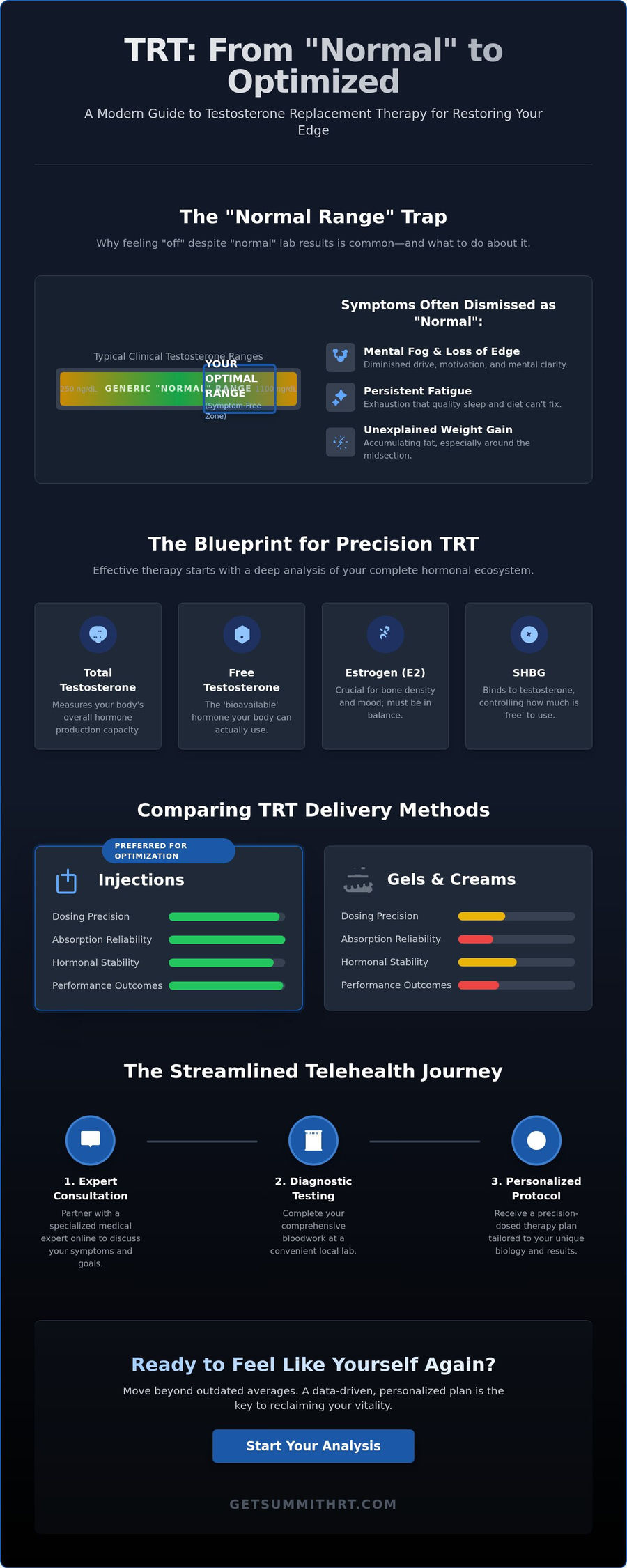
The "normal range" trap is the biggest snag for a lot of men. Clinical labs often use a broad statistical average that includes everyone from eighteen-year-old athletes to eighty-year-old sedentary men. If you fall anywhere in that window, a standard doctor might say you're fine. Being "clinically normal" is not the same as being optimized. Real trt therapy looks at your symptoms and your physiology, and aims for the level where you feel like yourself again.
Recognizing the Signs of Hormonal Imbalance
Hormonal decline usually creeps in. You might notice unexplained weight gain around the midsection, less lean muscle even when you're still training, and fatigue that sleep doesn't fix. The mental side is often worse. A lot of men describe a "loss of edge," or the drive that used to show up at work just isn't there. Traditional clinics often shrug and call it aging. We don't. These are manageable physiological symptoms, not a life sentence.
The Science of Optimization vs. Treatment
Optimization is about endocrine stability, not a single number. Steady, therapeutic testosterone levels help prevent the hormonal crash that leads to mood swings and energy dips. That stability has a psychological payoff too: clearer thinking and more confidence at work and at home. When hormones are in a better range, recovery from stress and training usually improves. TRT is a precision-dosed medical protocol, not a one-size-fits-all prescription.
How TRT Works: The Critical Role of Comprehensive Bloodwork
Effective trt therapy starts before the first dose, with a comprehensive bloodwork analysis that becomes the blueprint for your protocol. Without those labs, treatment is guesswork. We don't stop at one number. We look at how your hormones interact as a group. That's what makes the plan both safer and more useful.
A solid protocol looks at total testosterone, SHBG, and estrogen at the same time. Total testosterone tells us how much your body is producing. SHBG helps show how much of it is actually available for your tissues to use. If sex hormone-binding globulin (SHBG) is too high, even a high total testosterone level won't keep fatigue or brain fog away. We also monitor estrogen to keep it in a healthy ratio, because it matters for bone density and cardiovascular health in men.
Safety comes first. We track metabolic markers like lipids and hematocrit so blood viscosity stays in a good range and your heart stays protected. While we focus on optimization, managing the risks of testosterone replacement therapy requires this ongoing oversight. Precision dosing only works when we have frequent, detailed diagnostics to guide each adjustment. Knowing your biology is the starting point. You can start your comprehensive analysis today to see exactly where your levels stand.
Why Your 'Normal' Labs Might Be Lying
Standard reference ranges can mislead because they cover a huge demographic, from peak athletes to sedentary eighty-year-olds. If you're 35 but have the testosterone of a 70-year-old, a standard lab might still flag you as "normal." At Summit Rejuvenation, we interpret your labs based on your symptoms and performance goals. We read total testosterone alongside SHBG and estradiol, because the relationships between them tell us more than any single number.
Hormone Therapy for Women: A Necessary Perspective
Testosterone isn't only for men. It's an important hormone for women too, supporting libido, bone density, and mental clarity. In fact, women produce more testosterone by weight than they do estrogen. Women's trt therapy uses much lower doses and different delivery methods than men's protocols. When managed at optimized, therapeutic levels, there is no risk of masculinization. Women often notice a real return of energy and cognitive function that traditional hormone treatments frequently overlook.
Comparing TRT Delivery Methods: Injections vs. Gels and Creams
How you take the medication matters as much as the diagnosis. A lot of traditional providers start patients on gels or patches, and the results are often inconsistent. Intramuscular (IM) and subcutaneous (SubQ) injections are widely considered the better choice for modern trt therapy. Injections bypass the skin's barrier, so the full prescribed dose enters your bloodstream. That also removes the "transfer risk" of topicals, where the medication can rub off on family members or pets.
Gels and creams often create a "peaks and valleys" effect that messes with your day. You might feel a surge shortly after applying, then crash by late afternoon. Skin absorption changes with humidity, sweat, and even the application site. Standard pharmacy options often don't account for those variables. A protocol built around your metabolism can smooth that out and keep levels steadier through the week.
Testosterone Cypionate: The Industry Standard for Stability
Testosterone Cypionate remains the preferred choice because of its favorable half-life. It stays in your system longer, which creates more predictable hormone levels and means you don't have to dose as often. We often recommend micro-dosing, which means smaller, more frequent injections. That approach mimics the body's natural rhythm and helps you avoid estrogen spikes or sudden mood swings. Having the medication delivered to your home also cuts the pharmacy run, which makes it easier to stay consistent.
Addressing the #1 Objection: Is TRT Safe?
A lot of patients worry about long-term risks, often citing outdated studies about heart health or prostate issues. Modern research, including The Endocrine Society's guide to testosterone, helps clarify what hormone optimization actually looks like for men today. Under expert medical supervision, TRT is a highly controlled and safe method for restoring hormonal equilibrium. We use regular bloodwork to monitor your health markers and deal with potential side effects before they become problems. That oversight is what keeps trt therapy both effective and safe.
The Telehealth Journey: How to Get on TRT from Home
You don't need frequent trips to a doctor's office to start modern trt therapy. Telehealth has made hormone optimization a professional process that can fit into the schedule you already have. The steps are methodical and transparent, so you stay involved in the plan and still get expert guidance. Moving the clinical work online removes a lot of the friction that keeps people from getting help.
It starts with an initial consultation, where you talk through your symptoms and goals with a specialized provider. This isn't a rushed intake. It's a real look at how you feel and what you want. After that, you complete the comprehensive bloodwork at a local lab near your home. Once the results are in, our medical team reviews them and builds a plan based on your biology. Prescribed medications are then shipped to your door with clear instructions. You can schedule your initial consultation to begin this process today.
The Convenience of Modern Hormone Care
Telehealth skips the waiting room and the sterile-office feel. You connect with a provider who has time for education and follow-up through digital platforms. You're a partner in the plan, not a number in a queue. Summit Rejuvenation is set up to take you from "feeling off" to a better, more stable baseline with as little friction as we can manage.
What to Expect in Your First 90 Days
Improvements usually show up in stages as your body adjusts. Everyone responds a little differently, but most men follow a fairly predictable timeline during the first stretch of trt therapy:
- Weeks 1-3: You'll likely notice a significant improvement in sleep quality and a sharpening of your mental focus. The "brain fog" that once clouded your afternoons begins to lift.
- Months 1-2: This phase is defined by metabolic shifts and a noticeable increase in libido. You may find that your recovery after physical exertion is faster and your overall mood is more stable.
- Month 3+: By this point, the cumulative effects lead to visible changes in body composition, such as increased lean muscle and reduced body fat. Your energy levels become sustained throughout the entire day.
Beyond Testosterone: The Summit Approach to Total Optimization
Hormone optimization isn't one prescription and done. TRT is often the foundation, but the endocrine system doesn't work in isolation. We look at how testosterone interacts with your metabolism, recovery, and cellular energy. That's the difference between a generic prescription and a plan built around you. Symptoms are connected, and the follow-up has to be too.
We treat this as a long-term relationship, not a one-off script. We'll explain how each part of the protocol fits, so you're not piecing care together from three different offices. The aim is better than a clinical baseline: physical and mental performance that actually holds. That takes regular diagnostics and a provider who stays with the plan.
The Synergy of Peptides and TRT
Peptides are a useful tool in modern medicine. They act as signaling molecules that tell your body how to repair itself. Combined with trt therapy, peptides like growth hormone secretagogues can significantly enhance muscle-building and fat-burning results. If you're focused on medical weight loss, peptides like GLP-1 offer a powerful metabolic advantage by regulating appetite and improving insulin sensitivity. Recovery-focused peptides may also help support joint health and healing after hard training. Used together, the results can be faster and more sustainable than testosterone treatment alone.
Building Your Personalized Vitality Plan
Vitamin therapy supports cellular energy and immune function. Even with solid hormone levels, a micronutrient deficiency can leave you sluggish and slow to recover. Professional-grade vitamins in the protocol help make sure your cells have what they need. The same provider should also understand HRT, peptides, and weight loss, because those pieces interact. We'll keep adjusting as your needs change, so you're not left guessing about the next step. Start with Summit Rejuvenation today.
Reclaiming Your Edge through Precision Optimization
Getting your edge back is about more than a lab number. It's a careful, specific approach to your health. Moving past clinical "normal" ranges is often necessary if you want real performance. Comprehensive bloodwork is the blueprint, so every dose is based on your biology. Stable injection protocols, and peptides when they belong in the plan, give modern trt therapy a clear path to mental clarity and physical restoration.
Summit Rejuvenation runs this through bloodwork-driven plans and telehealth consultations, with medication shipped to your home. You don't have to settle for feeling less than your best. Schedule your Summit Rejuvenation consultation. We'll go through the labs and build the plan from there.
Frequently Asked Questions
How much does TRT therapy cost per month in 2026?
Pricing varies widely by clinic and by delivery model, so compare what's included rather than the headline number. Telehealth programs are often the most accessible option, while in-person clinics may add office visits and facility fees. At Summit, treatment is one flat monthly cost that covers medication, supplies and ongoing medical oversight, and it's confirmed with you before anything is charged.
Will TRT therapy make me lose weight or gain muscle faster?
Testosterone optimization significantly accelerates your ability to lose body fat and build lean muscle by improving protein synthesis and insulin sensitivity. While it isn't a "magic pill," it restores the hormonal environment necessary for your diet and training to yield maximum results. You'll likely find that your recovery times decrease and your strength increases, allowing for more productive training sessions and a leaner physique over time.
Is TRT therapy permanent, or can I stop treatment later?
Trt therapy is typically considered a long-term commitment because it addresses a chronic decline in natural hormone production. If you choose to stop treatment, your testosterone levels will likely return to their previous baseline, and your symptoms may reappear. However, stopping is possible under medical supervision through a protocol designed to help restart your body's natural production as efficiently as possible, though most men prefer the sustained benefits of ongoing care.
What are the most common side effects of testosterone replacement?
The most common side effects include mild skin changes like acne, temporary water retention, and a manageable increase in red blood cell count. Most of these are easily addressed through precision dosing and regular bloodwork monitoring. Because we track your markers so closely, we can make small adjustments to your protocol to mitigate these effects before they impact your quality of life or long-term health goals.
Can women benefit from TRT therapy, or is it just for men?
Women can experience profound benefits from trt therapy, as testosterone is a critical hormone for female libido, bone density, and cognitive clarity. In fact, women naturally produce more testosterone than estrogen by weight. Optimized, low-dose protocols help women reclaim their energy and mental focus without the risk of masculinization. This makes it a vital component of comprehensive hormone replacement for both genders who seek to restore their vitality.
How long does it take to see the mental benefits of TRT?
Most patients begin to notice mental benefits, such as improved focus and a lifting of "brain fog," within the first one to three weeks of starting treatment. This early phase is often marked by better sleep quality and a more stable mood. As your levels reach a steady state over the first 90 days, these cognitive improvements become more pronounced, leading to sustained mental drive and increased professional productivity.
Do I need a prescription to start TRT therapy?
Yes, you must have a valid medical prescription to legally start treatment because testosterone is a Schedule III controlled substance. A specialized provider must review your comprehensive bloodwork and medical history to ensure treatment is both necessary and safe for you. This professional oversight is essential for legal compliance and to ensure your protocol is precisely dosed for your unique biological needs and safety.
Can TRT therapy improve my sleep and brain fog?
Improving sleep quality and eliminating brain fog are two of the most frequently reported early benefits of hormone optimization. Testosterone plays a key role in regulating your circadian rhythm and supporting neurotransmitter function in the brain. By restoring your levels to an optimal range, you'll likely find it easier to fall asleep and wake up feeling refreshed, with a sharper mental edge that lasts throughout the day.